Gravity as Data Compression: Evidence of a Computational Universe?
Could gravity be more than just a fundamental interaction between masses? What if it's actually a manifestation of the universe optimizing its own information — a kind of cosmic data compression process?
Recent theoretical work proposes that gravitational attraction arises from information dynamics, suggesting that the universe operates less like a physical continuum and more like a computational system governed by informational laws.
From Physics to Infodynamics
At the heart of this idea lies the Second Law of Information Dynamics (Infodynamics), which states that in any isolated informational system, information entropy tends to decrease or remain constant over time.
This is the mirror opposite of the Second Law of Thermodynamics, where entropy — the measure of physical disorder — always increases. In the informational sense, the universe seeks to minimize informational complexity, evolving toward more ordered, optimized data states.
When combined with the mass–energy–information equivalence principle, this law implies that mass and energy themselves encode information — and gravitational attraction could be the natural result of reducing informational entropy between material objects.
Gravity as an Entropic Information Force
Under this model, gravity isn't a fundamental force but an emergent phenomenon — an entropic information force.
As masses move closer together, the informational description of their configuration becomes simpler and more compressed. The system's information entropy decreases, achieving a more stable and computationally efficient state.
In this framework, Newton's law of gravity can actually be derived from the second law of infodynamics, showing that gravitational behavior follows directly from the rules of information optimization.
This concept resonates strongly with Erik Verlinde's 2011 theory of entropic gravity, which proposed that gravity emerges from thermodynamic principles. However, this newer approach reframes the mechanism in terms of pure information processing, connecting it explicitly to computation and data theory.
A Discrete, Information-Based Space-Time
To explain how this works, space-time itself is treated not as continuous, but as discrete and quantized — a digital mesh made up of Planck-scale "cells".
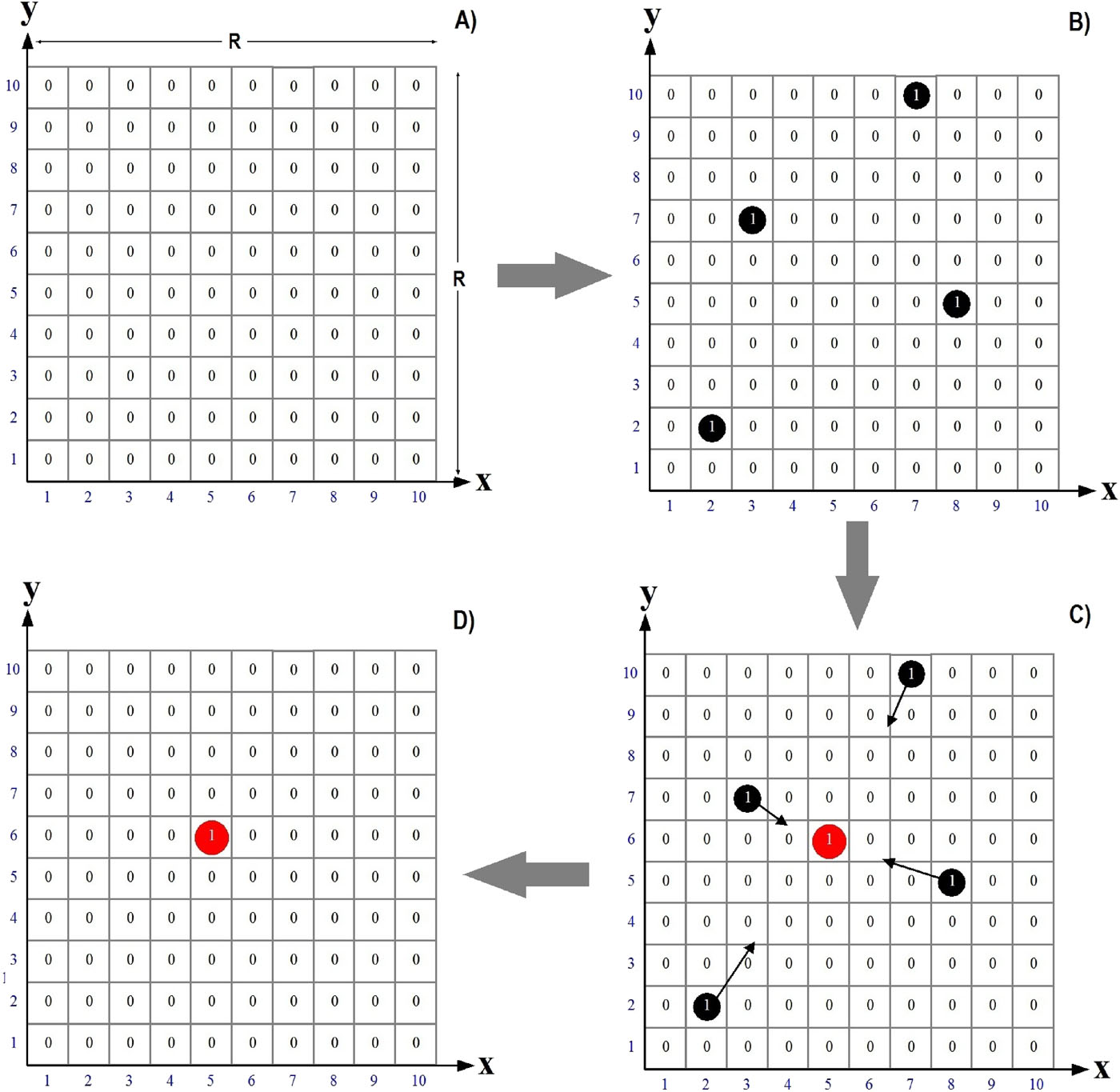
Each elementary cell, roughly 1.6×10⁻³⁵ meters in size, functions like a bit of data, capable of storing a single unit of information — "0" for empty, "1" for occupied by matter or energy.
This model aligns perfectly with the Holographic Principle, which suggests that all the information contained in a volume of space can be represented on its two-dimensional boundary — much like pixels on a screen or data blocks on a hard drive.
The universe, then, can be viewed as a finite-element simulation, where each cell continuously updates its state according to computational rules — the "source code" of physics.
Computation, Symmetry, and Optimization
In information terms, symmetry corresponds to data compression: highly symmetric structures require less information to describe, meaning less computational power.
Nature's tendency toward symmetry — from atomic orbitals to galactic formations — may therefore be a reflection of universal optimization, where physical laws are simply emergent properties of efficient computation.
Even the Pauli exclusion principle, which prevents identical fermions from occupying the same state, resembles variable handling in computer programming, ensuring distinct data identifiers for consistent processing.
Toward a Simulated or Computational Universe
If the universe consistently behaves in ways that reduce information entropy, maximize symmetry, and follow rules akin to computational optimization, then gravity itself may be one of the strongest hints that reality is fundamentally informational.
In such a view, the laws of physics are not just descriptive, but executive — the literal operating rules of a cosmic computation running at the Planck scale.
Gravity, then, would be the universe's way of organizing its data more efficiently, pulling matter together not through invisible forces, but through the logic of information compression.
Final Thoughts
This perspective doesn't replace traditional physics — it extends it, offering a deeper interpretive layer beneath space-time and matter.
If correct, it means that what we experience as "gravity" is a signature of computation, a measurable trace of the universe's drive toward informational equilibrium.
Perhaps, in the end, the universe isn't a grand machine at all —
but a perfectly optimized algorithm.

💬 Comments (0)
Share your thoughts and join the discussion
Please log in or register to leave a comment.
No comments yet. Be the first to share your thoughts!